Utility & Energy
Utility DOOH Advertising: Reach Every Ratepayer in Your Service Territory
A utility's audience isn't a demographic — it's a boundary on a map. Digital out-of-home fills that service territory with zero audience waste, then runs the messages only a utility owns: conservation, efficiency rebates, demand response, and storm response that flips on by county in hours. 663,760 screens nationwide, geofenced to the territory you actually serve. [1]
The category by the numbers
The argument
Why DOOH Works for Utilities & Energy
Your service territory already is the targeting
Every other advertiser pays to guess who their customer is. A utility doesn't have to — the customer is anyone inside the service territory, defined by a boundary you can literally draw on a map. Fill that boundary with DOOH and there is no audience waste, because every screen inside it reaches a current or prospective ratepayer. No demographic model, no lookalike, no leakage to people who can't buy from you.
Run messages no retail brand can run
Programmatic DOOH takes a live data feed, so creative can respond to real operational events instead of weather gimmicks. Trigger a conservation overlay off your own day-ahead load forecast — 'Grid's working hard today, shift usage after 8pm' — a heating-assistance message on a cold-snap advisory, or an efficiency-rebate push on a heat day. It maps to a genuine grid event, so no one can call it a gimmick. See geofencing.
A DOOH outage layer that flips on by county in hours
Utilities live and die on outage communication. Build the plan now — county-level sub-universes across the whole territory, safety and restoration creative pre-loaded, everything trigger-capable — and leave it dark. Storms and cold snaps are forecastable a day or two out, so when one is tracking in you activate only the affected counties within hours. Owning a channel that turns on for grid events is the kind of readiness leadership notices.
Presence is the proof you're investing locally
For a municipal utility or co-op, DOOH is how the community sees the grid it owns being reinvested in. Screens on the commute, at the grocery store, in the neighborhood panel down the block say we are here, this is your utility, your rates fund this. Rate cases, bond measures, and public trust all run on that visible, local presence — the thing a digital banner can never project.
Live inventory
Every Ratepayer Touchpoint You Can Buy Today
Real counts from live platform inventory, not estimates. Every venue below can be bought on its own, combined, or narrowed to a single county, town, or commuter corridor inside your territory. [1]
| Venue type | Screens | Avail. impressions / mo | Where they fit the plan |
|---|---|---|---|
| Grocery | 148,963 | 36.8B | Where households manage the monthly budget and the bills |
| Convenience Stores | 111,257 | 10.0B | Everyday neighborhood frequency, minutes from every home |
| Gas Stations | 121,098 | 3.2B | Forecourt and pump-top — the commuter and EV-switch moment |
| Office Buildings | 75,961 | 9.9B | Daytime reach for commercial and industrial accounts |
| Apartment Buildings | 66,655 | 7.0B | Reach renters and multifamily ratepayers where they live |
| Urban Panels | 36,172 | 19.4B | Street-level coverage, block by block, town by town |
| Gyms | 35,451 | 9.2B | Dwell time for efficiency and rebate content |
| Sports & Stadiums | 28,490 | 3.1B | Community presence and public-power brand trust |
| Billboards | 17,773 | 27.5B | Highway and commuter presence across the territory |
| Malls | 15,284 | 6.5B | Broad, territory-wide awareness |
| Transit (shelters, subway, rail) | 6,656 | 4.9B | Commuter corridors and downtown dwell |
| Total | 663,760 | ~137B | Nationwide, all markets |
Worked example
A Whole Service Territory, Zero Waste
CPS Energy is the largest municipally owned utility in the country, serving greater San Antonio. Here's its service territory with every bookable billboard, neighborhood panel, gym, and retail-center screen inside it plotted from real platform coordinates. Every dot is a ratepayer touchpoint — and this is before the grocery, convenience, gas, office, and transit layers. Any territory boundary you send produces the same map, down to a single county for a storm activation.
CPS Energy's San Antonio service territory — real platform inventory, not a render. Drag to pan, zoom in, click any dot for its venue type.
| Venue type | Screens plotted |
|---|---|
| Billboards | 120 |
| Neighborhood panels | 189 |
| Gyms | 232 |
| Retail centers | 78 |
| Mapped layers | 619 |
Live platform inventory inside CPS Energy's San Antonio service territory (~16 mi around downtown), August 2026. Only the billboard, panel, gym, and retail-center layers are plotted; grocery, convenience, gas, office, and transit screens add thousands more. Dot colors on the map match the rows above. [1]
The playbook
Seven Strategies That Work for Utilities
Each one is genuinely utility-native — grid events, program eligibility, and territory geography, not retail-brand tactics borrowed and relabeled. Combine two for full coverage: an always-on presence layer plus a trigger-ready program push. Four of the seven are mapped below with real platform inventory.
Grid-Honest Triggers, Not Weather Gimmicks
Precipitation forecasting is unreliable — a raindrop-on-the-screen story will burn a utility the first sunny day it runs. Temperature is predictable, and it maps to a message only a utility owns: peak-demand and conservation. Run always-on brand, then trigger a heating-assistance overlay when temps drop below a threshold and an AC-efficiency or rebate overlay on heat-advisory days. Better still, trigger off the utility's own day-ahead load forecast rather than weather at all — 'Grid's working hard today, shift your usage after 8pm.' No one can call that gimmicky, because it maps to a real operational event.
Pre-Built Storm-Response Plan That Sits Dormant
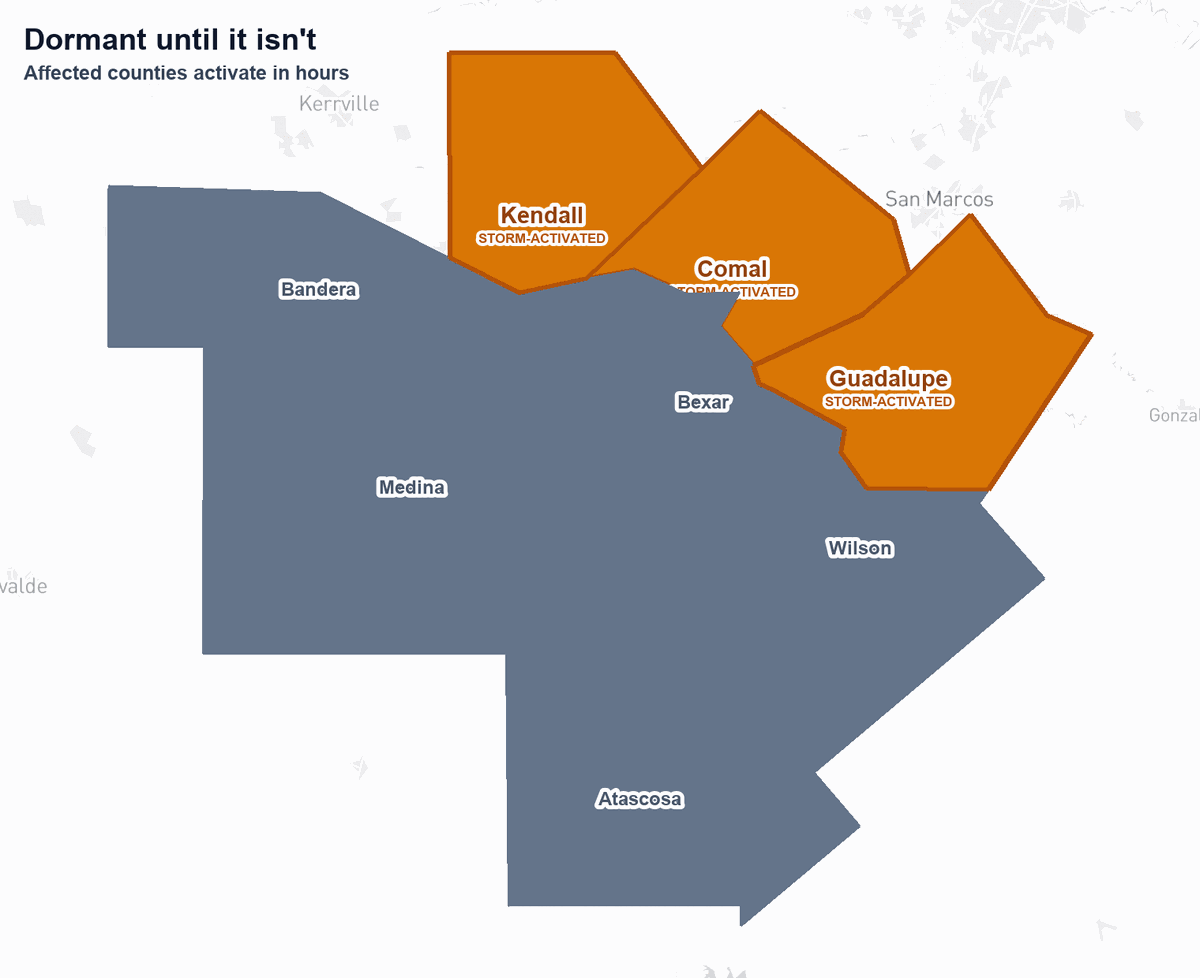
This is the strongest utility use case and it answers the 'personalization' ask without the creepiness. Build the plan now — county-level sub-universes across the whole service territory, safety, outage, and restoration creative pre-loaded, everything trigger-capable — and leave it dark. Storm tracks and cold snaps are forecastable a day or two out, so when a storm is coming you activate only the affected counties within hours. Utilities live and die on outage communication; owning a DOOH layer that flips on for storm events is a channel leadership actually notices.
Real county boundaries across the territory — Kendall, Comal, and Guadalupe activated for an incoming storm, the rest left dark until they're needed.
EV-Rebate Corridors, Not Blanket Geo
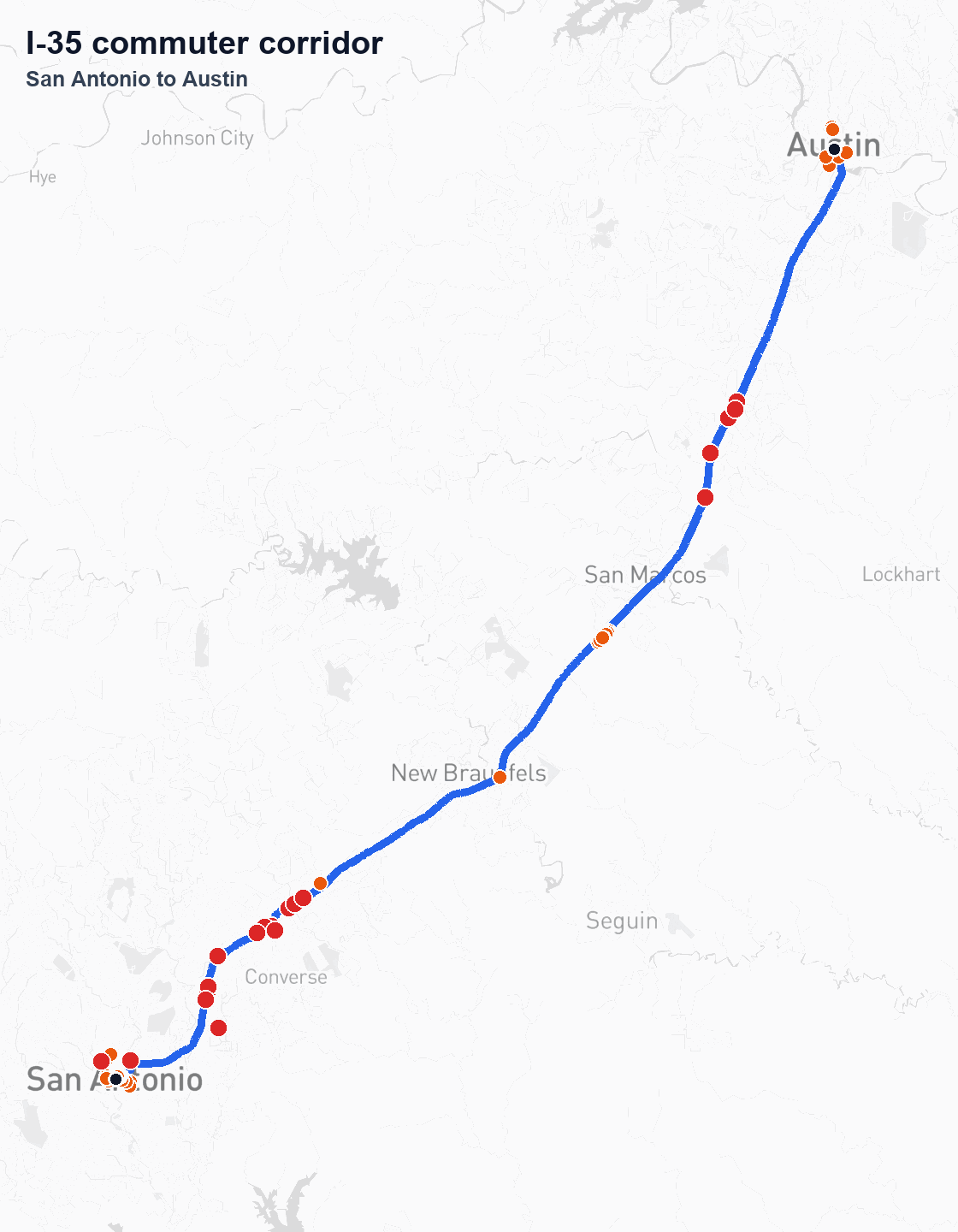
For commercial and residential EV-charger rebates, skip broad territory coverage and geofence the actual commuter routes and highway corridors between employment centers and the towns eligible for the rebate — DOOH campaigns can follow real road geometry. Layer in gas stations and EV-charging venue types so the 'switch to EV, claim your charger rebate' message lands at the most relevant moment. It turns a vague awareness buy into a targeted, story-able tactic.
The I-35 San Antonio-to-Austin commuter corridor: 45 billboards and 176 street-level panels along the real route, where the switch-to-EV message lands.
Venue-Contextual Targeting Mapped to Program Intent
With ~80 venue types available, match the venue to the utility action instead of buying reach for its own sake. Home-improvement and hardware-store screens for appliance and HVAC rebate messaging — people are literally deciding on a fridge or furnace. Gas pumps for EV-switch messaging. Gyms and salons for dwell-time energy-efficiency content. Malls and transit for broad awareness. It reframes a 'cover the whole territory' buy as intent-based rather than just wide.
Audience Layering by Program, Not Demographic Vanity
Utility program eligibility is a legitimate, natural reason to segment. Saver and coupon-interested households for rebate and assistance programs. Income filters to separate assistance-program outreach (LIHEAP-style) from solar, smart-home, and EV messaging. Spanish-language creative to multicultural households for assistance outreach. The segment always ties back to which program the household actually qualifies for.
Localized Creative — The Responsible Version of Personalization
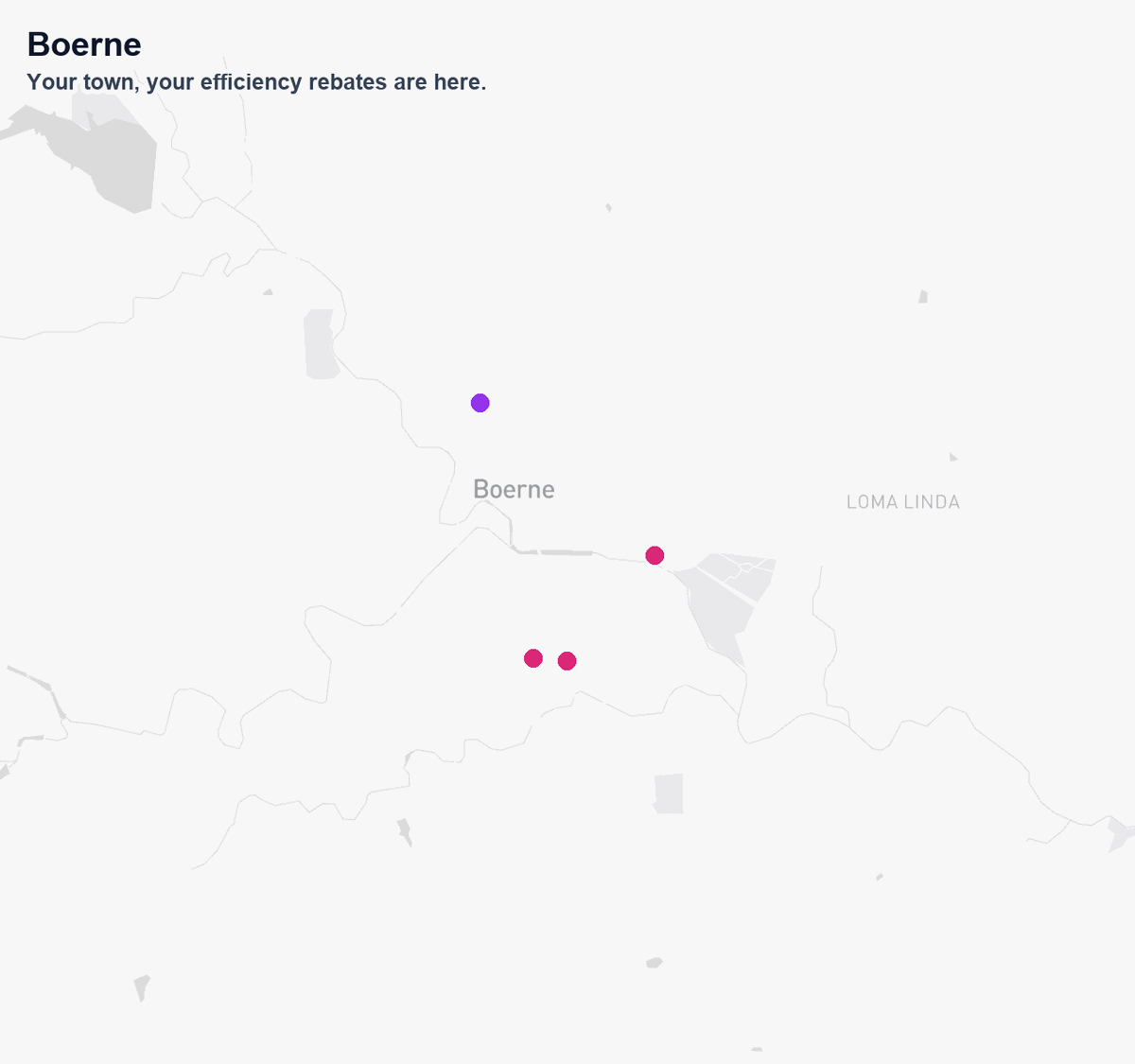
Build sub-universes of a handful of screens that represent a single town or two, then run town-named creative — 'Your town, your efficiency rebates are here.' Different line items, different creative, same buy. It scratches the personalization itch every utility marketer has without pretending to micro-target individuals, and it's honest about what the tech does: reach a place, not a person.
Boerne, one town in the territory — the handful of real, bookable screens that carry town-named rebate creative.
Prove Lift — Move From Awareness to Measurement
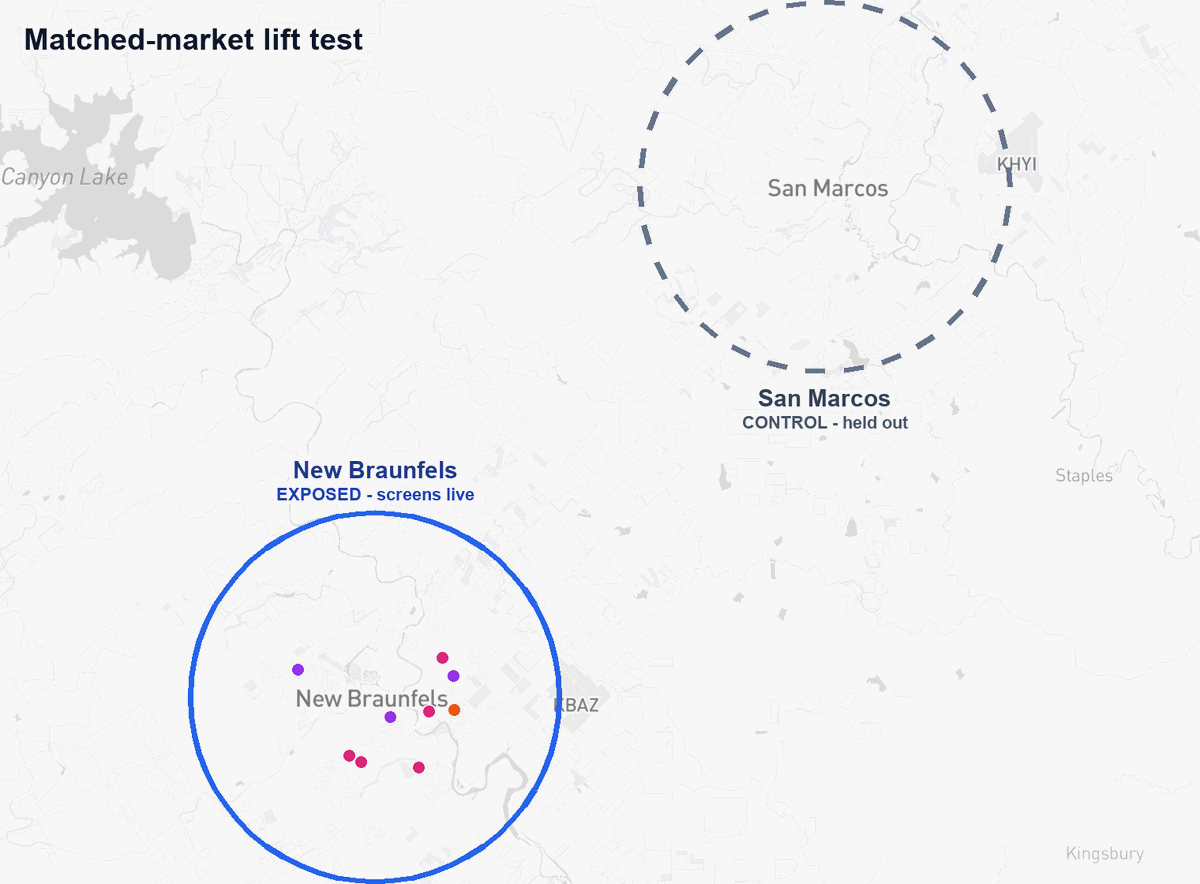
For a utility new to the channel, the single most valuable thing is showing lift. Use a period-comparison and control-city methodology: pick matched towns in the service territory — DOOH-exposed vs. held-out — and measure traffic to the specific program and rebate landing pages before and after. If the utility runs paid social, break ad sets out by county or postal code to get geo-granular conversions you can tie back to which DOOH regions performed. A clean lift study on even one efficiency program is what earns the budget to grow the channel.
A matched-market test: New Braunfels runs screens (exposed) while comparable San Marcos is held out (control), so program lift is measurable.
Who this is for
Built for the Whole Utility Team
Grow program awareness and public trust across the whole territory without audience waste.
Drive rebate and demand-response enrollment against a fixed program budget.
Own a county-level channel that activates for storms and grid events in hours.
Push charger rebates and beneficial-electrification offers along the right corridors.
Pricing
One Publisher floor price plus a 15% Goldfish platform fee on the media CPM. That's the Whole Price.
Pricing is set in your proposal. Scale the budget up or down and it simply buys more or fewer impressions across the same service territory — no tiers, no renegotiated rate when a single-county pilot becomes a full-territory build. Free AMAP audience data and white-labeled reporting included, and we handle creative approvals across thousands of screen owners.
Frequently asked
Utility DOOH FAQ
Keep planning
Sources
- Goldfish Ads platform inventory, August 2026 — available screens and monthly available impressions across grocery, convenience, gas station, office building, apartment, urban panel, gym, sports and stadium, billboard, mall, and transit venues, United States. Worked-example counts are the same inventory filtered to a ~16-mile radius around downtown San Antonio. The four strategy maps plot the same platform inventory along the I-35 corridor, within the CPS Energy county footprint, and within New Braunfels, San Marcos, and Boerne; basemaps © Mapbox © OpenStreetMap.
- ACEEE, Customer Energy Efficiency Programs — national ratepayer-funded energy efficiency spending totaled about $7.66 billion ($5.96B electric, $1.69B natural gas).
- ACEEE / Utility Dive, Efficiency, demand flexibility can meet growing data center loads — about 6% of US energy consumers participated in a retail demand-response program in 2024.
Ready to reach your whole territory?
Send the service-territory boundary and the program calendar — we return a costed plan inside a business day. Publisher floor price plus a 15% Goldfish platform fee on the media CPM, grid-honest triggers, audience data included.
Contact Us Now