DOOH Marketing
Gas Stations DOOH Advertising
Broadest demographic reach per dollar spent in DOOH. Drivers stand within arm's reach of the screen for 3–5 minutes with their phone typically pocketed — one of the highest attention-quality environments in the format despite short dwell.
Ready to run Gas Stations DOOH?
Build a plan across live inventory — publisher floor price plus a 15% Goldfish platform fee on the media CPM, usually go live within 24 to 48 hours of approval.
Who You Reach
Drivers during 3–5 min fuel stops — broadest demographic reach in DOOH
Format & Specs
Pump-top LCD or forecourt LED
Dwell: 3–5 minutes
Why This Venue
Gas stations outperform their CPM on brand recall because the audience is captive and phone-down. Proximity to convenience stores creates a direct path to purchase. High traffic volume, broad demographic reach, and low CPMs make gas stations essential for any national DOOH plan.
Strategic Insight
Phone is typically pocketed during fueling — one of the few moments in modern life where a screen has zero competition from the device in someone's pocket.
Screens in the Wild
Gas Stations DOOH Screens
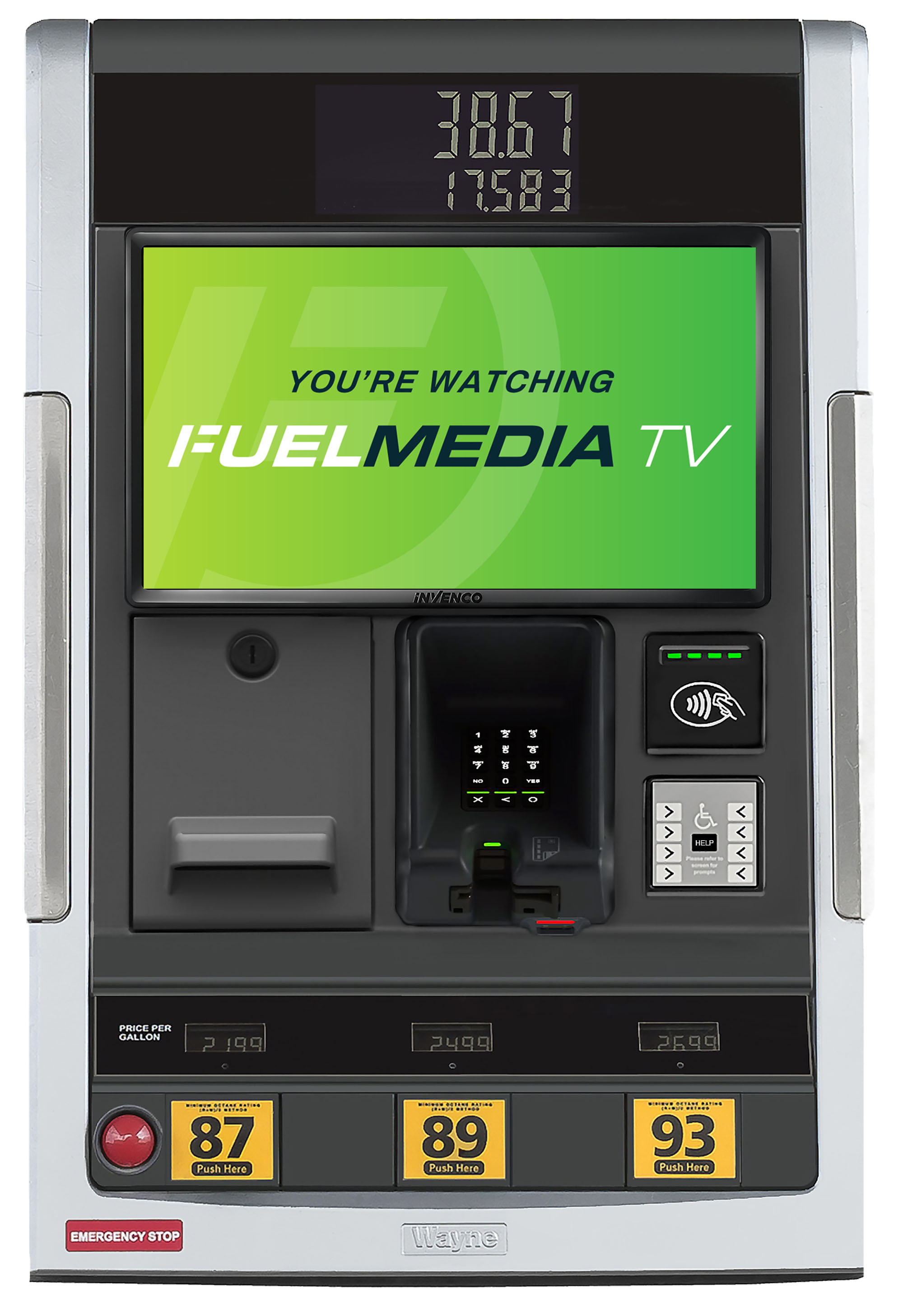
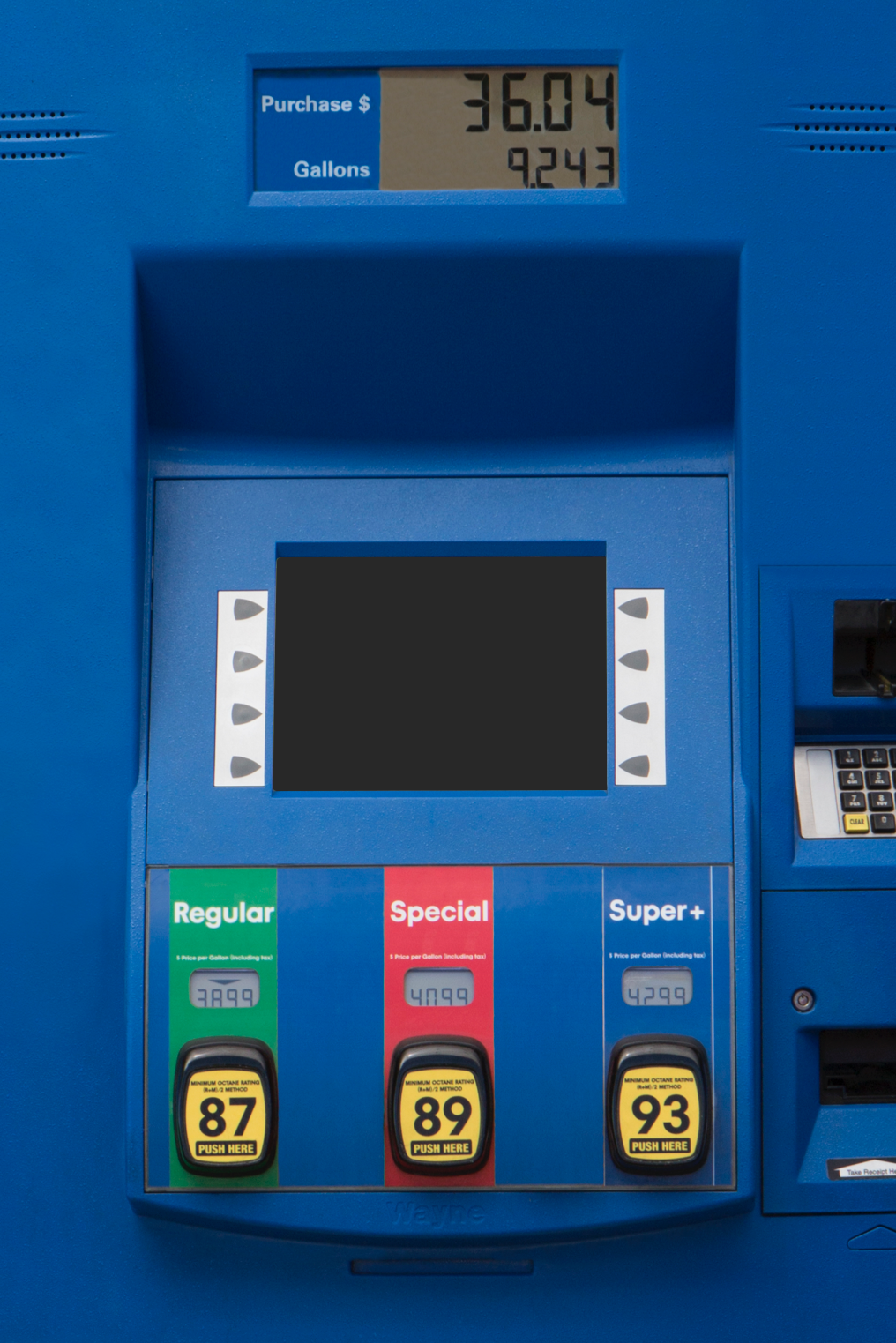
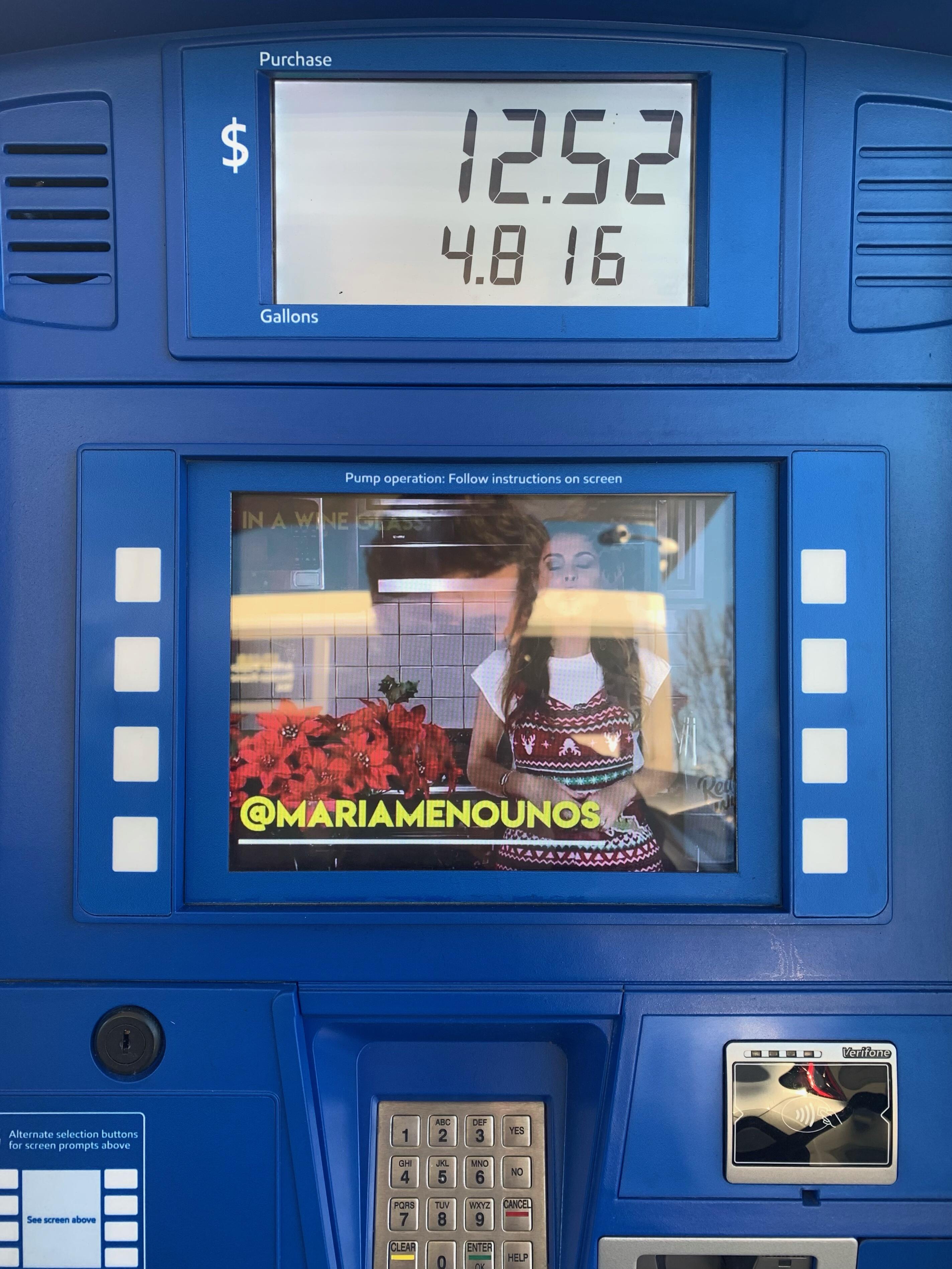
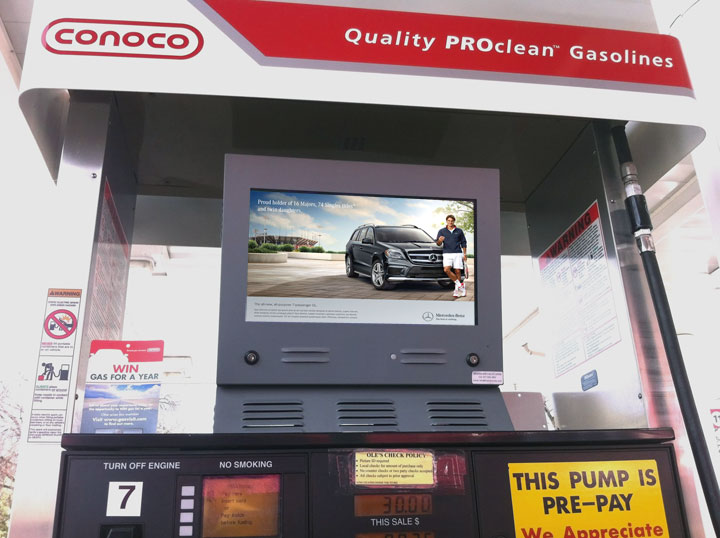
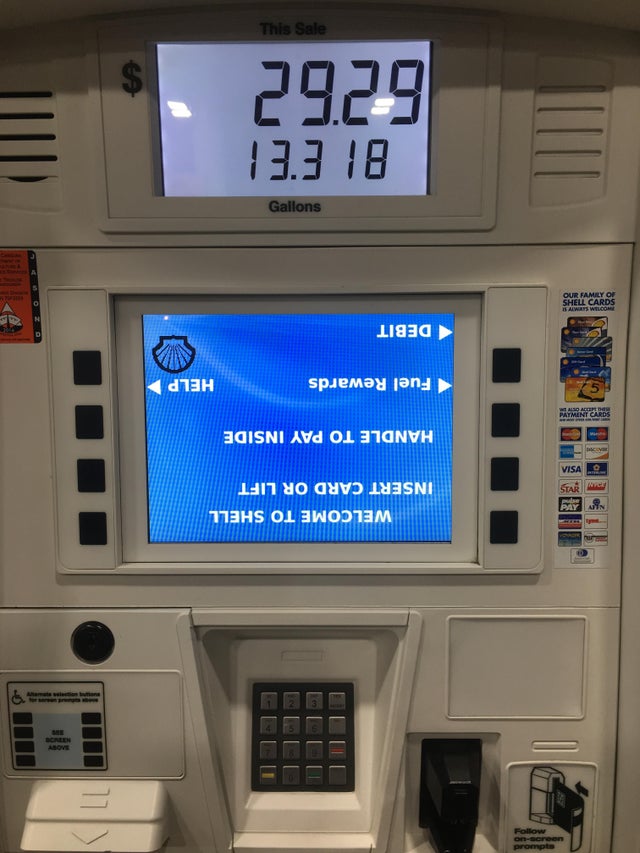
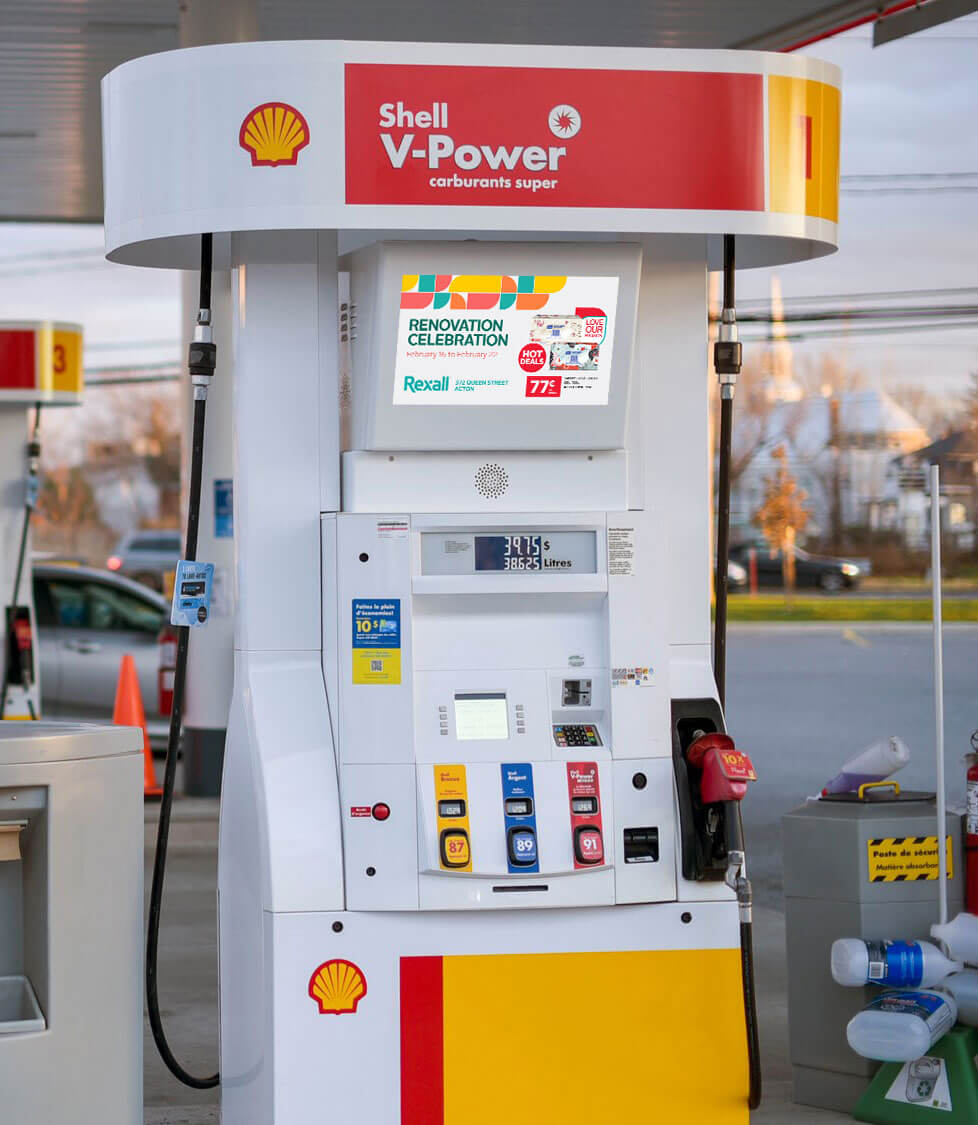
Sample gas stations inventory from publishers active across the network.
The Point of View
The Forecourt Is One of the Last Places a National Audience Stands Still and Looks Up
The gas-station forecourt is one of the last places in American media where a large, national audience stands still, looks up, and is primed to spend — all at the same time. Roughly 122,620 U.S. convenience stores sell fuel (an eight-year high), the channel serves on the order of 160–165 million customer visits a day, and a single fuel-selling store averages about 1,100 customers daily. People are captive for several minutes at eye level, with no scroll, no skip, and no ad-block.
The dominant network in the category, GSTV, reports ~115–116 million unique monthly viewers (Comscore-measured) and an attention profile that beats CTV and linear TV. Crucially, the "fuel day" is a high-spend day: independent card-spend analysis shows people spend roughly 3.7x more in the three hours after fueling than people who didn't fuel.
For the right advertiser — QSR, CPG, auto, insurance, retail, financial services — the forecourt is not a billboard; it is a measurable, purchase-adjacent video moment. Our recommendation is to treat it as a planned, layered buy (national video + programmatic flexibility + in-store point-of-purchase), measured to the KPI that matters, and priced transparently.
Scale of the Channel
Why the Moment Matters: Scale + Behavior
151,975
U.S. convenience stores operating as of Dec. 31, 2025
Source: NACS / NIQ TDLinx
122,620
C-stores selling fuel — an 8-year high
Source: NACS / NIQ TDLinx
~80%
Of all fuel purchased in the U.S. sold through c-stores
Source: NACS
~160M
Customers served by the channel per day
Source: NACS
165M
Daily visits cited by PepsiCo — half the U.S. population
Source: PepsiCo
1,100
Average daily customers per fuel-selling store
Source: NACS
$837.4B
U.S. c-store industry sales in 2024
Source: NACS
$476.3B
U.S. fuel sales in 2025 (–5.4% YoY)
Source: NACS
The "Fuel Day" Is a Spend Day
The Forecourt Catches People in an Active Spending Mindset
This is the single most important fact for an advertiser. The forecourt doesn't just deliver eyeballs — it catches people while their wallet is open and their next stop is already planned.
3.7x
More spend in the 3 hours after fueling vs. non-fuelers
Source: Affinity Solutions, via GSTV
2.4x
More grocery spend when shoppers fuel before the trip
Source: Catalina
3.9x
More spend at stores on a viewer's regular journey within 3 hours of a gas-station visit
Source: GSTV
The Audience & The Attention Case
A Multi-Minute, Eye-Level, Low-Distraction Window
Dwell time: approximately 4–7 minutes at the pump (AdQuick); other operators cite 3–5 minutes (Screenverse). Either way, it is a multi-minute, eye-level, low-distraction window — a rarity in modern media.
Non-skippable by design: drivers can't scroll past, skip, or ad-block a forecourt screen or pump topper.
Attention Metrics — GSTV / Lumen Research, IAB NewFronts 2024
95%
Eyes-to-screen rate
2.7x
More attention than CTV (vs. TVision norms)
2.5x
More attention than linear TV (vs. TVision norms)
7,702
Attentive seconds per 1,000 impressions (Dentsu / Lumen)
36%
Post-exposure brand recall after fuel-up — ~1.5x Dentsu benchmark
Honest caveat: not everyone watches — some people pump and go. The data above is real and third-party-supported, but an advertiser should weight the moment for attention and recall, not assume universal engagement. GSTV itself frames auto/insurance buys as "large attentive audience" plays rather than instant-sale plays.
The Media Landscape
Who's Who at the Pump
The forecourt is not a single vendor. There are national video networks, programmatic-native networks, EV-charging networks, and traditional static/point-of-purchase formats. A smart plan often blends them.
National Video Network — The 800-lb Gorilla
GSTV (formerly Gas Station TV) — the only consolidated, scaled digital video platform in the convenience & fuel channel.
- ~27,000–29,000 fuel-retailer locations; ~115–116 million unique monthly viewers (Comscore); reaches 1 in 3 American adults monthly; operates in roughly 200–210 markets.
- Full sight, sound, and motion video at the pump; short-form content from partners (ESPN, CNN, weather, etc.).
- Retailer footprint includes 7-Eleven, Arco, BP, Circle K, Chevron, Phillips 66, Exxon-Mobil, Gulf, Kwik Trip, Marathon, Speedway, Sunoco.
- CEO: Sean McCaffrey. Positioned as a brand-safe, politics-free environment — a selling point that has grown in demand.
Programmatic-Native Forecourt Networks
- FuelMedia TV — 8,000+ digital video screens across 40 DMAs, built on Invenco pay-at-pump terminals; fully programmatic. Accessible via Vistar Media and Place Exchange (now part of Broadsign), with distribution through Screenverse; expanding to additional SSPs. Buyable direct or programmatically (open exchange, PMP, programmatic guaranteed).
- 4Court Media (Dover Fueling Solutions) — 27" and 12" displays at major retailers including Exxon, Shell, Mobil, bp, ampm, Chevron; accessible via Screenverse.
EV Charging — The Emerging Complement
EOS Linx and others — EV charging DOOH. Different audience profile and a dramatically longer dwell (40+ minutes vs. ~5 at the pump). Worth pairing as EV adoption grows; complements rather than replaces fuel inventory.
Static & Point-of-Purchase — The Closer
Pump toppers, nozzle ads, window clings, in-store displays. Lower-cost, high-frequency, and ideal for sealing the conversion the forecourt video opened. Goldfish does not recommend QR codes in these placements — see Creative below.
How It's Bought & What It Costs
Indicative Market Rates
Rates vary by market, format, daypart, and volume.
| Format | Typical Pricing | Buy Path |
|---|---|---|
| Static pump topper | $150–$600 per display / 4-week cycle | Direct / managed |
| Digital forecourt video | Programmatic, market-variable rates | Direct or programmatic |
| EV charging screens | Premium inventory, market-variable rates | Direct or programmatic |
| Goldfish Ads (DOOH curation) | Flat, transparent rate; no platform fee | Managed + visualization-first planning |
Programmatic plumbing: the main SSPs/exchanges that carry forecourt inventory are Vistar Media (1.1M+ screens aggregated), Broadsign / Place Exchange (Broadsign acquired Place Exchange in Nov 2025; ~1.8M screens globally, with programmatic-guaranteed live in Google DV360), Hivestack, and VIOOH. Despite this, 59% of marketers still buy OOH only via direct deals — so programmatic flexibility is still a competitive edge, not a default.
Measurement & Attribution
This Channel Can Prove ROI
Gas-station DOOH is far more measurable than legacy out-of-home. Note the model: networks like GSTV deliberately do not identify individuals; measurement runs through third-party panels, mobile-location matching, card-spend analysis, and MMM — not 1:1 person-level tracking. Set KPI expectations accordingly.
Reach & frequency
Comscore (the de-facto third-party currency here); Samba TV for deduplicated reach vs. linear TV.
Foot traffic / visitation
Foursquare, iSpot.
Sales lift
Catalina, Circana, Affinity Solutions, Mastercard.
App / web / behavior
Kochava, MFour, PlaceIQ (location).
Proof Points
- Applebee's (GSTV × IPG MAGNA, via iSpot): forecourt video alone drove +12% foot traffic; paired with CTV, +22%; paired with digital, +27%.
- Samba TV reach study (national QSR): GSTV added double-digit incremental reach to a national linear campaign and delivered 5x the impression share of light-TV viewers vs. linear — i.e., it reaches the people TV is losing.
- National mortgage lender (Comscore × PlaceIQ): measurable lift in website visitation/conversion from forecourt exposure.
Best-Fit Advertisers
Which Advertisers Win at the Forecourt
QSR & Restaurants
Proven foot-traffic lift; the "hungry, on-the-go, near a location" moment is ideal.
CPG (food, beverage, snacks)
The c-store/grocery retail-media tie-in and the in-store closer make this a natural; the fueler is often the immediate consumer.
Auto & Insurance
Large, attentive audience plays; a captive car owner is on-target by definition.
Retail (big-box, home improvement, specialty)
Proximity targeting — e.g., pumps within a few miles of a store that carries the brand.
Financial Services
Demonstrated web-visitation and conversion lift.
Local & Regional Services, Civic / Public-Info
Geo-precise, cost-efficient reach.
Creative Best Practices
How to Design for the Forecourt
- Lead with sight + sound + motion; keep spots short (15 seconds is the workhorse length).
- Design for sound-off. Audio is often configurable or mutable and is regulated for volume; the spot must land visually without sound.
- Big, legible, eye-level. Single message, brand early, large type readable from arm's length at a pump.
- No QR codes. Goldfish does not include QR codes in forecourt creative or plans — they don't function reliably in the DOOH/forecourt environment (hands busy, brief glance, glare, distance). Drive action through recall + proximity (the store is steps away) and an in-store/point-of-purchase closer instead.
- Use the data layer: dayparting, geo, proximity-to-retail, and weather triggers (programmatic) to make every impression contextually relevant.
- Stack "entice → close": forecourt video opens the loop; pump topper + in-store POP closes it in one uninterrupted sequence.
Risks & What to Watch
An Honest Read on the Channel
- Attention isn't universal — some drivers pump and go. Weight the buy for recall and reach, supported by the attention data.
- Fuel volumes & the EV transition — fuel sales dipped 5.4% in 2025 and EV adoption is a long-term headwind; but fuel-selling locations are at an 8-year high, and EV charging DOOH (40+ min dwell) is an emerging complement rather than a cliff.
- DOOH inventory constraints — the category is supply-limited; plan national flights early to secure inventory.
- Brand safety / content review — networks enforce content policies (e.g., restrictions on explicit or political-attack creative); build in approval lead time.
- Measurement model — expect panel/location/MMM-based attribution, not deterministic person-level conversion.
Macro Context
Where DOOH Is Heading
$4B
U.S. OOH in 2026 (+4.1% YoY)
Source: Guideline tracked pool
14.5%
DOOH growth rate (vs. 1.5% for traditional formats)
Source: Guideline
~40%
Of all OOH spend forecast to be digital by 2026
Source: OAAA
55.9%
Of DOOH's 2025–2029 growth driven by in-store retail media
Source: Industry forecast
80% of consumers say they're likely to act after a creative or engaging OOH ad (StackAdapt). DOOH is healthy but decelerating, with inventory — not demand — as the constraint. Programmatic DOOH is the fastest-growing slice, and the forecourt/c-store sits squarely inside the retail-media environment driving that growth.
How the Forecourt Is Catalogued on Goldfish
Verified Inventory Taxonomy
Forecourt media on the Goldfish planning platform is catalogued against the OpenOOH global venue taxonomy, the same classification used by major DSPs and SSPs to route programmatic DOOH. That alignment lets a planner request "gas stations" once and have it resolve consistently across publishers, SSPs and measurement partners.
Primary venue
Retail | Gas Stations
OpenOOH venue category 201. Encompasses pump-toppers, forecourt video and station-perimeter screens.
Adjacent venue
OpenOOH venue category 202. Captures the in-store cooler, queue and check-out screens that close the loop on a forecourt impression.
Because the two venue types share a footprint (the same 122,620 fuel-selling c-stores), Goldfish surfaces them as a single planning unit when a brief calls for "the forecourt." A buy can be layered with the broader retail set — Grocery (203), Drug Store (204), Mall (205) — when the goal is full path-to-purchase coverage rather than fuel-day attention alone.
The Goldfish Recommendation
How to Enter the Forecourt
If you are a brand evaluating the forecourt, here is how we would advise you to enter:
- Buy the moment, not just the reach. The forecourt's value is a captive, attentive, purchase-primed window — brief it that way internally so creative and KPIs match.
- Blend the buy. Use national scale (GSTV) where you need it, and programmatic forecourt (FuelMedia / 4Court via Vistar / Broadsign) for flexibility, geo-precision, and price control.
- Layer audience with AMAP. Goldfish's AMAP / Geograph Census-Block-Group cohorts and proximity-to-retail targeting sharpen a broad channel into the right neighborhoods and commutes — cookielessly.
- Stack formats. Forecourt video to entice; pump topper + in-store POP to close.
- Measure to the KPI. Foot traffic → Foursquare / iSpot; sales → Catalina / Circana / Affinity; reach → Comscore / Samba.
- Price it transparently. Goldfish runs a flat, all-in rate with no platform fee and visualization-first planning — so you see exactly what you're buying and where.
- No QR codes. Design for recall and proximity action.
Top Markets for Gas Stations DOOH
Industries That Buy Gas Stations
Gas Stations Case Studies & Benchmarks
Plan a Gas Stations Buy
DOOH Advertising Guide
How digital out-of-home buying works, end to end
Programmatic DOOH
Buy screens the way you buy the rest of your media
DOOH Targeting
Audience, geo, venue, and daypart targeting options
Geofencing & POI
Radius, competitor, and store-level targeting
proof-of-play reporting by tactic
Screen photography attached to delivery reporting
PMP vs Managed Service
Which buying route fits your team
Planning resources
More like Gas Stations
Venue types with the same audience
Campaigns with a similar mix
Markets that fit this plan
Related on the Goldfish Taxonomy
Continue Down the Path-to-Purchase
Retail · OpenOOH 201
Adjacent venues
Convenience Stores
On-the-go consumers, 2–3 visits per week average, broad demographic
EV Charging Stations
EV owners — HHI $100K+, early adopters, tech-literate, sustainability-oriented
Grocery Stores
Primary household shoppers, 15–25 min dwell, active purchase intent
7-Eleven
High-frequency convenience shoppers, consistent national footprint
Best-fit verticals
Plan a Campaign in Gas Stations
Get platform access and start building your DOOH media plan.
Contact Us Now