The short version
- — No on roadside: banned by the largest US operator, and physically impossible at 10:1.
- — Yes only where the viewer is stationary, close, and not driving.
- — Permission is not the same as worth doing.
- — A vanity URL does the same job on 100% of inventory.
- — Attribution no longer needs a scan.
<100
Intentional clicks per million impressions for a standard banner ad
Single digits
Realistic scans per million impressions for DOOH (our planning assumption)
0
Public, independent DOOH scan-rate benchmarks that exist
#1
US roadside operator that bans them outright on billboards
Goldfish Ads does not include QR codes in DOOH plans by default. Not as a style preference — because on most of the screens we buy, they physically cannot be scanned, and on a lot of them they aren't permitted. If your venue mix and your offer clear the bar below, we'll build it and we'll say so. Otherwise we'll put a vanity URL there and give you the space back.
The short answer
If you have thirty seconds, here it is.
Do not put a QR code on a roadside billboard. It is not permitted by the largest operator in the United States, it is unsafe, it is illegal to act on in most states, and even if all three of those were untrue it would need to be roughly twenty-five feet across to work.
You can put one on a screen where a person is standing still, close, and not driving — a gym, an elevator, a waiting room, a bar, a transit interior, a store aisle. On those screens the physics work.
But "the physics work" is not the same as "it will get scanned." It will get scanned if, and only if, there is something behind the code worth interrupting a person's day for. A discount. A free item. A ticket. An entry. Not "learn more." Not a homepage.
And for everything else — which is most campaigns — a short, spellable vanity URL does the same job with none of the constraints, runs on every piece of inventory in the market, and gets you placement-level attribution anyway.
That's the whole argument. The rest of this page is the evidence.
Even when the venue accepts them, we still say no
Most of this page is about where QR codes are impossible. This section is about the harder case: the screens where they're perfectly legal, perfectly scannable, and still the wrong call.
Here's the comparison nobody makes.
A standard display banner ad has an average click-through rate of roughly 0.05% to 0.1%, with the Google Display Network average sitting around 0.046% — call it four to five hundred clicks per million impressions. But a large share of mobile display clicks are accidental fat-finger taps rather than intent, so the number of people who genuinely meant to click is well under a hundred per million. That is normal performance for the most frictionless response mechanism in advertising.
Now count what a banner click actually costs the user. The device is already in their hand. The ad is already on the screen they're already looking at. Their finger is already on the glass. It is one tap. And still, well over nine hundred and ninety-nine thousand people out of every million never meant to.
Now count what a DOOH QR scan costs.
- 1.Notice the screen at all, in an environment full of competing stimulus
- 2.Decide the offer is worth acting on, in the next two seconds, before the spot rotates
- 3.Stop what you're doing — walking, talking, waiting, shopping, working out
- 4.Retrieve the phone from a pocket or bag
- 5.Unlock it
- 6.Open the camera
- 7.Frame the code at the right distance and angle, without glare on the screen
- 8.Wait for recognition, then tap the notification
- 9.Wait for the page to load on venue wifi or congested cell
Nine steps against one. Each step sheds most of whoever is left. That is not a marginal difference in conversion rate — it is a different order of magnitude entirely.
Our planning assumption — not a published benchmark
We plan DOOH on the assumption that a QR code on qualifying inventory returns scans in the single digits per million impressions, and effectively zero on everything else. We want to be explicit that this is a modelled assumption derived from the friction ladder above and from banner CTR as an upper bound — not a figure from a study, because no credible study exists. We would rather show you our reasoning than quote you a number we can't defend. If anyone hands you a DOOH scan rate expressed as a percentage, ask them for the methodology.
Put those side by side and the conclusion is unavoidable. The QR code is not a slightly weaker response mechanism than a banner click. It is orders of magnitude weaker, deployed in a medium with none of the click's advantages, occupying space in a format that has less room to spare than any other channel you buy.
So the recommendation is not "use QR codes only where they're permitted." The recommendation is: don't use them. Not on roadside, where they're impossible and banned. And not on gym screens and elevator panels either, where they're allowed — because "allowed" was never the bar. The bar is whether that fifth of your creative would work harder as a message than as a barcode almost nobody will point a camera at. It nearly always would.
The exceptions are real but narrow, and they're set out further down. Treat them as exceptions, not as a menu.
The physics nobody checks: the 10:1 rule
A QR code has a minimum viable size relative to how far away the camera is. The working standard used across the QR industry is a distance-to-size ratio of roughly 10:1 — a code intended to be scanned from ten metres away needs to be about one metre across, before you add the mandatory quiet zone around it. That figure comes from Delivr's QR implementation guidance for billboards and OOH, and the same 10:1 ratio appears in Pageloot's 2026 industry benchmark write-up specifically in reference to billboards. See also our DOOH creative specs for the format sizes this ratio has to fit inside.
That ratio is not a design guideline. It's a function of camera resolution and module size. You cannot creative-direct your way around it.
Now apply it to real inventory. This is the table that ends most QR conversations.
| Format | Viewing distance | Required QR size at 10:1 | Verdict |
|---|---|---|---|
| Highway bulletin (14' × 48') | 250–500 ft | 25–50 ft | Impossible |
| Junior poster (11' × 22') | 100–150 ft | 10–15 ft | Impossible |
| Digital roadside spectacular | 200–400 ft | 20–40 ft | Impossible |
| Taxi top / vehicle wrap | 20–60 ft, both parties moving | 2–6 ft | Impossible |
| Transit shelter (exterior) | 6–15 ft | 7–18 in | Possible |
| Urban panel / street furniture | 6–12 ft | 7–14 in | Possible |
| Airport gate hold screen | 10–15 ft | 12–18 in | Possible |
| Bar / restaurant screen | 8–12 ft | 10–14 in | Possible |
| Mall directory / kiosk | 2–4 ft | 3–5 in | Comfortable |
| Gym cardio-deck screen | 3–5 ft | 4–6 in | Comfortable |
| Elevator / office lobby screen | 3–6 ft | 4–7 in | Comfortable |
| Grocery aisle / checkout screen | 3–5 ft | 4–6 in | Comfortable |
| Gas pump topper | 2–4 ft | 3–5 in | Comfortable |
| Doctor's office waiting room | 4–8 ft | 5–10 in | Comfortable |
Add the quiet zone. Standard implementation calls for a margin of at least four modules of clear space on all sides. On the creative, that means the real footprint of a QR code is meaningfully larger than the code itself — and it must be clear space, so you can't run your image or your headline through it.
Why a billboard specifically cannot take a QR code
Five separate reasons, each independently disqualifying. They stack.
- 1.The code would be bigger than the sign. At a 10:1 distance-to-size ratio, a bulletin read from 250 to 500 feet needs a code 25 to 50 feet across. A standard 14' x 48' bulletin is fourteen feet tall. There is no version of the creative where the code fits, let alone leaves room for the ad.
- 2.The exposure window is too short. A driver's view of a roadside board is a matter of a few seconds between the sign entering useful sightline and passing out of it. The nine-step scan sequence does not fit inside that window. It does not fit inside three of those windows.
- 3.The viewer is operating a vehicle. Handling a phone while driving is illegal in most states. The action the creative is requesting is one the viewer cannot legally perform, and the advertiser is the party asking them to perform it.
- 4.The angle and motion defeat the camera. Even at a red light, a code on a board is being read off-axis, at distance, through a windscreen, often against direct sun or at night against a high-brightness LED panel that blows out the camera's exposure. QR decoding needs contrast and geometry. Roadside gives it neither.
- 5.The operator won't run it. Lamar's published programmatic policy is that QR codes may not be displayed on billboards. Even if you solved the other four, the largest roadside operator in the country will reject the creative.
Any one of these ends the conversation. All five together are why "can we just make the code bigger" is not a workable note, and why this is a plan-stage decision rather than a design problem.
A large share of the inventory won't accept it anyway
This is the part media buyers find out after the creative is built.
Lamar Advertising — the largest roadside operator in the United States, with more than 4,600 large-format roadside digital screens across 170+ DMAs — states it plainly in its own programmatic FAQ: QR codes may not be displayed on billboards, though they are acceptable for transit advertising or street-level media when the code is not intended to be read by drivers. Which venue types a plan leans on decides most of this before the creative is ever built.
That is not a Goldfish opinion. That is the supply side's published spec.
It is not isolated.
- — Ströer, one of the largest European operators, specifies on its DOOH City Board sheet that QR codes are not permitted on advertising materials in Munich.
- — In Dubai, QR codes are not permitted on traditional outdoor formats — billboards, lampposts, mupies, bridge hoardings — under Dubai Municipality regulations. They are allowed only on approved digital formats, including screens inside RTA-licensed taxis, but not on taxi exteriors.
- — DOmedia, an OOH marketplace, describes the same landscape from the buy side: in many cases QR codes are not permitted; some vendors disallow them entirely, others restrict by market, and some restrict at the level of the individual billboard. Their stated recommendation is to use a website or phone number instead — something a viewer can remember or say to a voice assistant.
- — Vistar Media, a DOOH supply-side platform with no reason to talk anyone out of DOOH creative, notes that scanning a code from a roadside billboard would require a driver to take their eyes off the road, which is why most states have outlawed the practice on highway billboards.
What this means operationally
- You shrink your addressable inventory pool before the plan is built. Roadside is the largest impression pool in the channel. Design it out and you've removed the volume floor from your own campaign.
- You guarantee mid-flight creative rejections. Publisher creative review will bounce it, usually after the IO is signed, and you'll be re-cutting under deadline.
- You pay a delivery penalty. Rejected creative means unfilled slots, which means you either under-deliver or scramble makegoods.
The fix is not "get approval." The fix is to decide at plan stage whether your venue mix is a QR mix at all. If it isn't, don't design one in.
The AdCP DOOH creative standard even encodes the assumption in reverse: DOOH formats have no clickthrough URL, and QR codes are the named workaround. The industry has quietly built its spec around an element most of its inventory won't display.
On scan rates: be suspicious of every number you've been quoted
We looked for a credible, independent, DOOH-specific QR scan-rate benchmark. There isn't one. That absence is itself the finding, and it's worth being direct about rather than filling the gap with a number we made up.
Here's what actually exists, and who published it.
"12–18% scan rates on digital billboards for promotional offers."
Published by Blip, a company that sells digital billboard advertising. No methodology, sample size, or campaign count disclosed.
"2.8x higher engagement for QR-driven digital campaigns."
Attributed to unspecified "regional OOH insights" by a Dubai hoarding agency. No underlying study named.
"QR codes on OOH increase response rates by 2x–4x vs. print codes."
Appears in a 95-stat listicle with no source attached to the line.
"An average scan rate of 14% is a strong indicator of successful marketing."
Published by Pageloot, a QR code generator. This figure is cross-industry — it blends restaurant table tents and healthcare check-ins with billboards, and the same article notes that essential-service scans exceed 70%, which is what's pulling the average up. It is not an OOH number.
QRCodeKIT — a company whose entire business is selling QR codes — published an out-of-home playbook in July 2026 stating that there is no universal benchmark worth trusting, because performance depends on format, dwell time, creative, and offer.
When the QR vendors themselves say the benchmarks are unreliable, treat any 12–18% figure you're shown by a media seller as a sales asset, not a measurement.
What we can say with confidence
Scan-through rate is scans divided by the media owner's estimated impressions for that unit. In DOOH, the denominator is enormous — a single roadside digital screen can deliver millions of impressions a month. Any scan count you generate is being divided by that number. Even a campaign that produces a genuinely healthy volume of scans will produce a scan rate that rounds to approximately zero, because that's what happens when you divide a four-figure number by a seven-figure one.
The impressions figure a scan rate gets divided by is an independently measured audience estimate — Geopath and equivalent measurement bodies produce it, not the media owner — which is exactly why the ratio is so punishing.
This cuts both ways, and we'll be fair about it: a low scan rate does not mean the QR code failed. It means scan rate is a bad metric for a mass-reach medium. Which is precisely the argument for not treating the QR code as your attribution strategy.
The one adjacent measured benchmark that does exist with published methodology is CTV. BrightLine reports QR code scan rate as a standing quarterly KPI, defined as scans over total visible impressions, tracked through eMarketer's Industry KPI series as of Q1 2026, with a 100,000-impression campaign minimum. The figure sits behind an eMarketer subscription so we won't quote it secondhand. But note the shape of the comparison: CTV is the friendliest possible environment for a QR code — the viewer is seated, indoors, stationary, phone almost certainly in hand, code on screen for the full length of a 15- or 30-second spot. If a scan rate in that environment is worth tracking as a discipline rather than celebrating as a number, a highway bulletin at 65 mph is not going to outperform it.
"But I need it for attribution"
This is the real reason QR codes end up on DOOH creative. Not because anyone believes people will scan a billboard — because the media buyer needs a number to bring back to the client, and a scan is a number.
Two problems with that.
First: OOH already generates measurable digital response without a code
Nielsen's OOH Online Activation research found that OOH advertising generates a search response among roughly 46% of US adults over a six-month period, and that OOH accounts for a disproportionate share of gross search activations — in the range of 22–26% of search activations generated across TV, radio, print, OOH and banner combined, against roughly 7% of the combined ad spend. That's an index of roughly three to four times the rate you'd expect from its spend share.
Nielsen's later OOH study found 33% of respondents used a search engine to look up an advertiser after seeing an OOH ad, 23% visited the advertiser's website, and 15% visited their social page.
OAAA's DOOH-specific Nielsen work found nearly two-thirds of DOOH viewers took at least one measured action after seeing a digital billboard — website visits, online search, store visits, social activity — with 54% of smartphone-equipped viewers having taken an action on their device after seeing a digital billboard in the past year, and approximately 60% after a digital transit ad.
Second: DOOH attribution has moved on, and a scan is now the weakest tool in the kit
Available today on a standard DOOH buy, none of which require anything in the creative:
- Device ID passback from screens exposed to the media, retargetable across other channels or usable for in-house attribution
- Foot traffic lift studies against a matched control
- Geo-holdout testing: exposed markets vs. clean markets
- Brand lift and sales lift studies
- Web conversion measurement studies
- Search lift: exposed-DMA query volume vs. control, which measures the behaviour the Nielsen data says is actually happening
- Placement-level delivery data — venue, screen, creative, daypart — which every Goldfish campaign ships with as standard
A QR code measures the small number of people willing to interrupt themselves. These methods measure everybody. Choosing the QR code as your attribution mechanism means choosing to measure the least representative slice of your audience and then reporting it as if it were the campaign.
The five gates. All five, or don't run it.
We're not absolutists. There are DOOH executions where a QR code is the right call. They are narrower than most briefs assume, and they all look like this.
Gate 1
The viewer is stationary and close
Dwell of roughly fifteen seconds or more, viewing distance under about ten feet, viewer standing or seated, not operating a vehicle. Qualifying: gym cardio decks, elevators and office lobbies, medical waiting rooms, bars and restaurants, transit interiors, in-store aisle and checkout, salons and barbershops, laundromats, campus screens, gas pump toppers, mall kiosks. Disqualifying: all roadside, all vehicle-mounted, all large-format at distance, most transit exteriors.
Gate 2
The publisher permits it, confirmed before production
Not assumed. Checked, per publisher, per market, in writing, before the creative is built. This is a plan-stage question, not a trafficking-stage question.
Gate 3
The offer is worth interrupting a life for
Ask honestly: would you stop what you're doing, take out your phone, and point it at a screen for this? A real percentage off. A free item. A ticket or entry. A time-limited drop. An appointment slot. A menu at the moment of ordering. “Learn more,” “visit our site,” “follow us,” and “download the app” are not offers. They are the absence of an offer wearing a call-to-action's clothes.
Gate 4
The destination is one step and mobile-native
The scan lands on the thing that was promised. Not the homepage. Not an app store interstitial. Not a form with nine fields. Not a page that takes four seconds to render on a congested cell network in a crowded venue. If the person has to hunt after scanning, you've spent your one moment of intent on a bounce.
Gate 5
You're measuring it against a control
Run the QR version and a vanity-URL version against comparable inventory, and compare total response — scans plus direct traffic plus branded search lift — not scans alone. If you never test it, you'll never know, and you'll keep running it because it produced a number.
The real price of a QR code is the creative it displaced
Set aside scan rates entirely and think about the ad as a piece of real estate. For context on what a DOOH campaign costs per impression, that fifth of the creative is not free space.
A DOOH spot is typically eight to fifteen seconds. The viewer's actual attention on it is a fraction of that. Across the channel, the working rule is that a piece of DOOH creative supports about six to eight words of message before comprehension collapses — and roughly five creative specs cover the majority of inventory in the market, so you are not designing something bespoke and expansive. You're designing something small and fast.
Into that, a scannable QR code plus its required quiet zone typically claims fifteen to twenty-five percent of the usable creative area. Sized honestly for the viewing distance, it's often more.
So the trade is: roughly a fifth of your message space, given to an element that — on qualifying inventory, with a real offer — a small minority of viewers will act on, and on non-qualifying inventory, zero will.
What that same space buys instead
- A larger, faster-reading headline. The single biggest driver of DOOH recall.
- The product, shown bigger. In DOOH the pack shot frequently is the message.
- An actual price or offer stated in words. "$5 breakfast, before 10am" outperforms a code leading to a page that says $5 breakfast.
- A proximity cue. "Two blocks ahead." "Next exit." "In this building." Location relevance is a lever no other channel has, and it's free.
- A dayparted or dynamic message. Weather, time, inventory, sports score, traffic. This is what digital screens are for.
- A brand asset at recognisable scale — logo, colour block, mascot, wordmark — doing memory work.
- Whitespace. On a screen glimpsed for four seconds, empty space is a performance feature.
A QR code is a link. DOOH's job is not to be clicked. It's to be remembered long enough that the person searches for you later — which, per Nielsen, is exactly what they do.
The same "response click" mental model was borrowed from CTV, and the comparison mostly doesn't survive — see DOOH vs CTV for why a scan mechanic that struggles on a couch cannot rescue one at 65 mph.
What to run instead
The vanity URL
A short, spellable, memorable URL does everything the QR code was supposed to do and clears every constraint on this page. It runs on every piece of inventory in the market — including programmatic DOOH. No publisher bans it. It's legible at any distance if you set it in type — no 10:1 problem. It works for drivers, because they can remember it or say it to a voice assistant. It costs a fraction of the creative space. And it's fully trackable.
Rules for a DOOH vanity URL:
- Short enough to read in under two seconds. Under about 20 characters total.
- Spellable on hearing it. No ambiguity between "to/two/2" or "for/four/4."
- No hyphens. No underscores. No numbers if avoidable.
- All lowercase in the type, regardless of the actual domain.
- Set it large. It's a call to action, not a legal line. If it's small enough to be mistaken for a disclaimer, it will be.
- Unique per market or per format. brand.com/nyc, brand.com/chi, brand.com/gym. This is how you get placement-level attribution without a scan.
- 301 it to a tracked landing page with UTMs behind the scenes. The viewer sees something clean; your analytics see everything.
The search prompt
Given that search is the dominant digital response OOH produces, prompt it directly. A line reading "search: [distinctive brand term]" leans into behaviour that is already happening, works at any distance, works for drivers, requires no scannability, and is measurable through branded search lift in exposed markets versus control markets. Only works if the term is distinctive enough to own the SERP. Test it before you buy the media.
The spoken phone number
Underrated for local, service, and high-intent categories. A memorable number can be dialled hands-free, remembered from a moving vehicle, and tracked with a unique call-tracking number per market — which gives you cleaner market-level attribution than most scan data ever will.
SMS shortcode
"Text OFFER to 12345." Voice-executable, distance-independent, works at speed, and captures an owned channel rather than an anonymous page hit. In several respects this is the QR code's job done better: it acquires a contactable customer instead of a session.
What that space is actually worth: seven things a DOOH screen can do that a QR code can't
The argument against the QR code is only half an argument if nothing replaces it. The reason we want that fifth of the creative back is that a digital screen is a programmable surface, and almost none of what it can do involves asking someone to take out their phone.
Everything below is standard on a Goldfish plan, not an upcharge.
No. 1
Conditional creative that changes with the world
Copy that swaps on a live condition rather than a schedule. A quick-service brand running a hot-coffee message below 45°F and flipping to iced above 70°F, on the same buy, in the same hour, market by market. An urgent care centre surfacing "walk-ins open until 9" only on the screens within its own catchment, only on evenings its wait time is under twenty minutes. The trigger is a data feed; the creative is a template with variable fields. This is the version of "interactivity" DOOH is actually good at — the screen reacts to the viewer's situation instead of asking the viewer to react to the screen. See how we build DOOH targeting rules.
No. 2
Proximity copy that a QR code can never earn
"Two blocks ahead." "Next exit, on the right." "In this building." A tire chain buying only the screens on the approach roads to its own bays, with the turn written into the headline. Location relevance is the one lever no other channel has, it costs nothing, and it is legible at 400 feet. More on geofencing and radius targeting.
No. 3
Audience, not just geography
Our AMAP audience data is built on census-block cohorts rather than cookies, so a plan can be built against who lives, works and moves through a block rather than a rough radius drawn on a map. Useful when the buyer's target is a behaviour or a household profile rather than a postcode. See AMAP census-block audience data.
No. 4
Retargeting the people the screen actually reached
Device IDs seen in front of the media can be passed back and re-engaged on mobile and CTV. This is the honest version of the thing the QR code was standing in for — a bridge from the physical impression to a digital one — except it captures the whole exposed audience instead of the fraction willing to stop walking. More on DOOH retargeting and device-ID passback.
No. 5
Proof it ran, with a photograph
Nine times out of ten, when a client asks for a QR code what they're actually asking for is evidence the money turned into something real. A scan count is a terrible proxy for that. A timestamped photo of the creative on the physical screen is not. See proof-of-play reporting by tactic.
No. 6
Dayparting down to the moment
A screen outside a stadium is a different medium at 6pm on a game night than it is at 11am on a Tuesday. Buying the moment rather than the day is a planning decision, made before the flight, that costs nothing to execute and routinely does more for response than any element inside the creative. See dwell time and audience by venue type.
No. 7
Screens where the purchase decision is being made
Grocery aisle, endcap, checkout, convenience, pharmacy. The last screen before a hand reaches for a shelf. Worth noting: these are also the only environments where a QR code is physically scannable — and they're precisely the environments where the shopper is about to transact anyway, which is why a message beats a link even here. More on retail media and CPG screen networks.
None of the seven require anything from the viewer that a QR code does. You can run it programmatically, take curated packages inside your own DSP seat, or hand us the brief and we'll assemble it — either way the creative still has to hit the specs your creative has to hit, and none of those specs need a barcode in them.
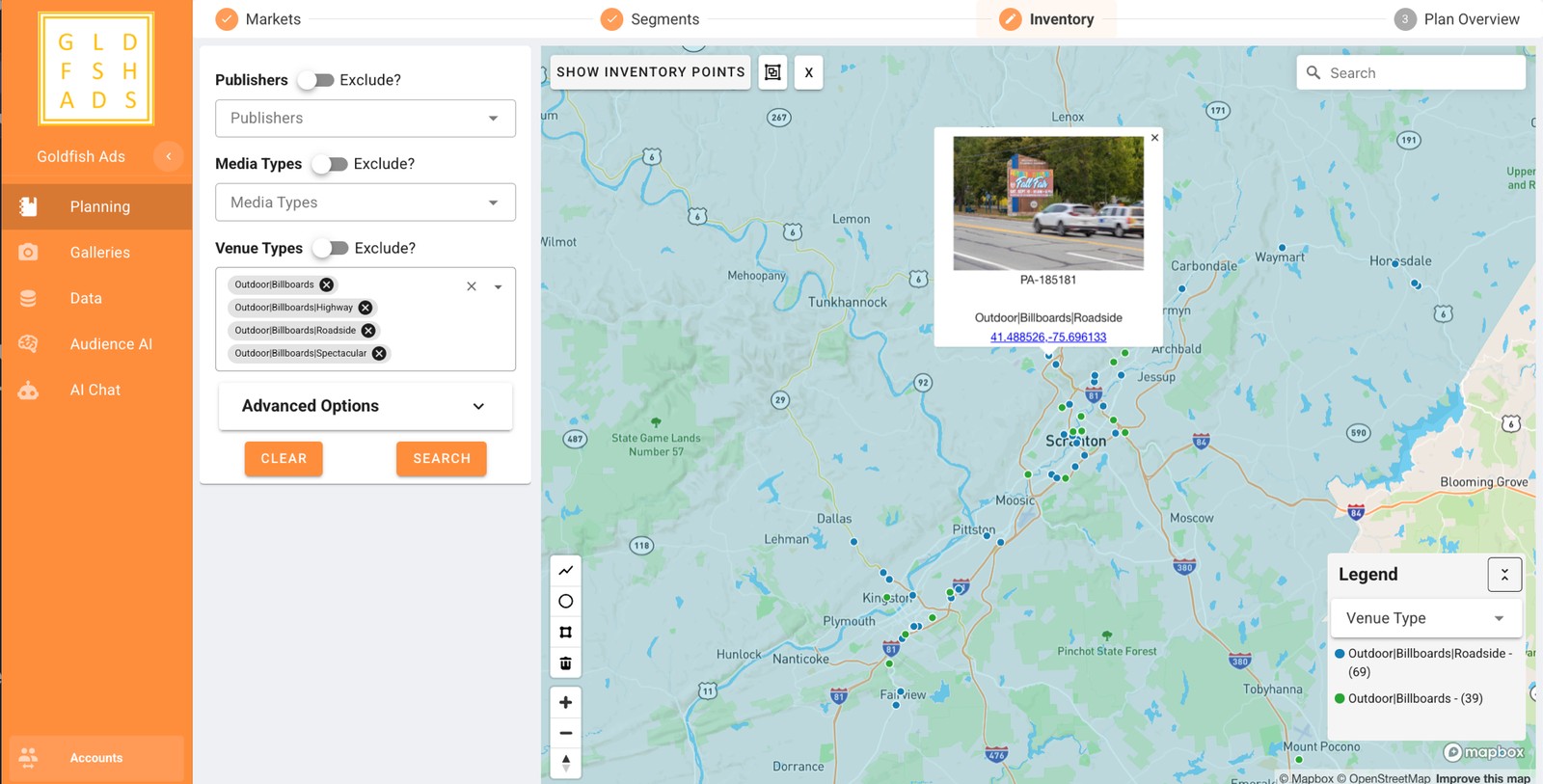
Custom plan, custom mockups, real maps — delivered in one business day
The reason most briefs arrive with a QR code already specified is that the plan and the creative got built in different rooms, weeks apart, by people who never saw the units. We collapse that.
Send us an advertiser, the markets, a budget and a flight window. What comes back:
- A screen-level plan. Venue mix, unit counts, impressions and cost at our publisher floor price plus a 15% Goldfish platform fee on the media CPM — not a range, not a rate card with a footnote. Every unit named.
- Mockups on the actual screens. Your creative rendered onto the real inventory, not a generic stock billboard. It's how you find out in advance that the headline is four words too long, or that the code you were going to put in the corner would need to be twenty-five feet across.
- A map. Every billboard we sell is databased in Google Maps in 360°, so you get the real sightline for each unit — approach angle, obstructions, what's actually in front of it — instead of a pin on a map.
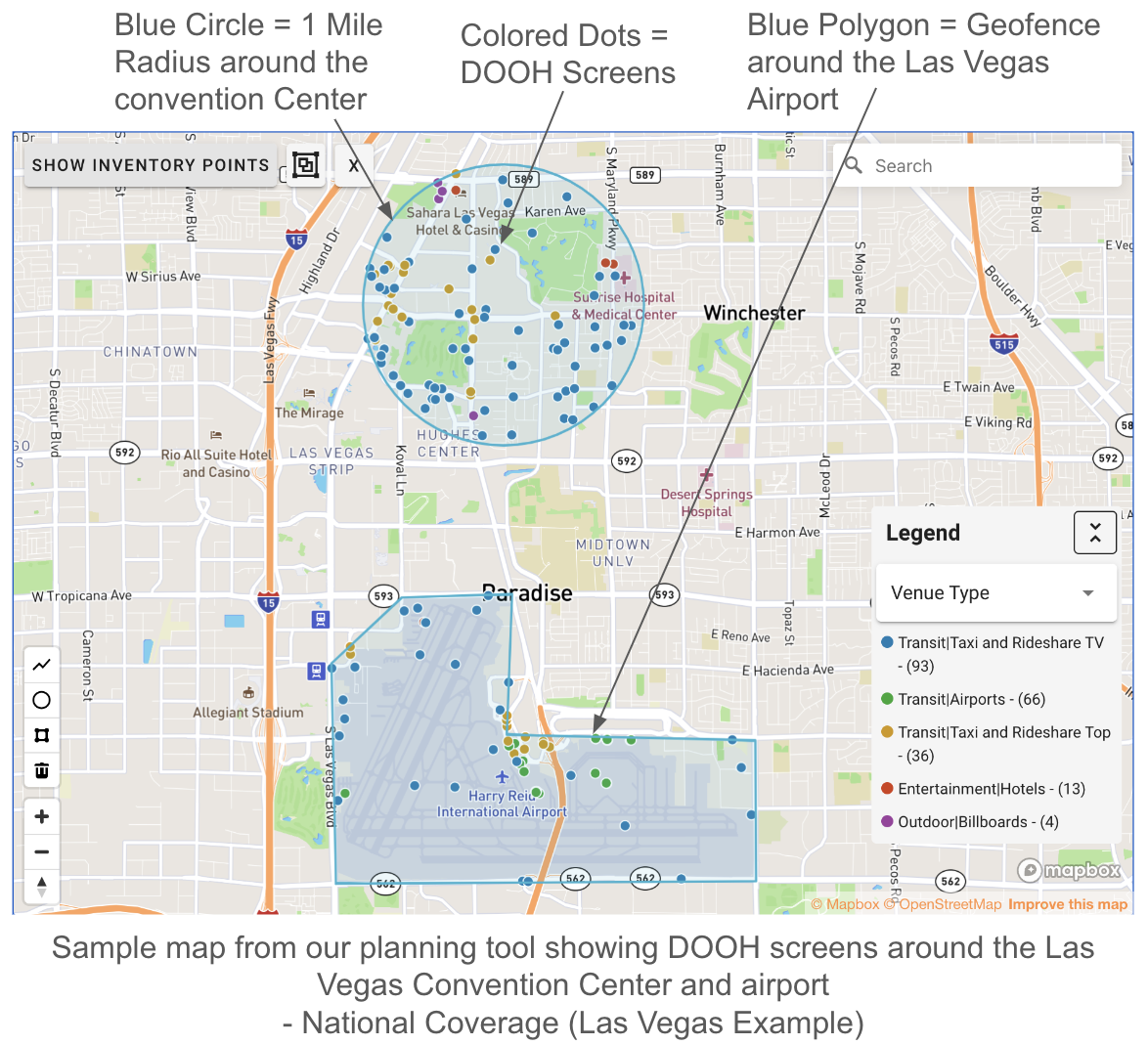
No IO, no signed anything, no cost to see it.
Related, in the same workflow: see the creative work, browse the mockup gallery, review 360° street-level views of the inventory, walk through a day in the life of a single audience, look under the hood at the AI planning tools we build on, read why buyers work with us, or just send us the brief.
How we handle it
Our default answer is no. Not "no unless the publisher allows it" — no.
We don't include QR codes in DOOH plans, because on the inventory where they're permitted the response is orders of magnitude below a banner click, and on the inventory where most of your impressions live they're physically impossible and contractually prohibited. Either way you've spent creative space you can't get back.
When a brief arrives with one specified, we don't just traffic it. We check whether the venue mix in your plan physically supports it, using actual viewing distances from the units — we have every billboard in Google Maps databased in 360°, so we look at the real sightline instead of guessing. We check the publisher creative specs for every unit in the buy, per market, before creative production, so nothing gets rejected after the IO is signed. And we come back to you with a straight answer: how many of your screens can legally run it, how many can physically resolve it, and what we think the code is likely to return against what the same space would return as message.
If you still want it after that, we'll build it and we'll measure it properly against a vanity-URL control so you find out for real. We're not going to refuse to execute your creative. We're just not going to let you buy it without knowing what it costs.
And if the answer is don't — which it usually is — we build the alternative into the plan at no extra cost: vanity URL structure, per-market tracking, search-lift measurement design. That's just planning.
Frequently asked questions
Usually not. Lamar Advertising, the largest roadside operator in the US, states in its programmatic FAQ that QR codes may not be displayed on billboards, though they're acceptable on transit or street-level media not intended to be read by drivers. Other operators restrict them by market or by individual unit. Beyond permission, a code scannable from typical highway viewing distance would need to be roughly 25 feet across, which is larger than the height of a standard 14' × 48' bulletin.
Sources
- Lamar Advertising programmatic FAQ — Programmatic FAQ (QR codes not permitted on billboards; permitted transit/street-level).
- Ströer — DOOH City Board specifications (QR codes not permitted, Munich).
- Dubai Municipality regulations on QR restrictions for billboards, lampposts, mupies and bridge hoardings.
- Delivr — QR codes for Billboards, OOH & DOOH: 10:1 distance-to-size ratio, four-module minimum quiet zone.
- Pageloot — Industry QR Code Scanning Benchmarks, 2026.
- QRCodeKIT — QR code on out-of-home: a playbook, July 2026.
- Vistar Media — Cracking the code: using QR codes to upgrade your DOOH ads, February 2026.
- DOmedia — QR Codes and OOH.
- Nielsen — OOH Online Activation Survey.
- Nielsen — 2019 Out of Home Advertising Study.
- OAAA / Nielsen — DOOH Engages Consumers and Drives Activations.
- eMarketer / BrightLine — CTV QR Code Scan Rate Industry KPI, Q1 2026.
- AdCP — DOOH creative channel specification.
- Blip — Reach and Frequency in OOH (cited as vendor-published).
- Google Display Network / OwlClaw display benchmarks 2026 — average display CTR 0.046%–0.1%.
- Searchlab / Google Display Network Benchmarks 2026 — programmatic display CTR 0.08%.
Further reading
- OAAA — Out of Home Advertising Association of America, the US industry body; its research library is the standard starting point for OOH effectiveness data.
- OAAA/FOARE + Harris Poll DOOH study (April 2024) — Study conducted online by The Harris Poll, April 2–9 2024, among 1,023 US adults aged 18–64: 73% of consumers view DOOH ads favourably, and 76% of recent DOOH viewers said they had taken action because of one.
- OAAA updated OpenOOH venue taxonomy (February 2026) — The standardised venue definitions used to describe what environment a screen sits in. Relevant here because venue type is what determines whether a QR code is physically viable.
- OAAA + Winterberry Group, "The Power of Proximity" (March 2026) — OAAA with Winterberry Group on OOH's role in commerce.
- Geopath — The US OOH audience measurement organisation whose impression estimates sit underneath most US inventory — and the denominator that makes any DOOH "scan rate" round to zero.